


In today’s data-driven, customer-first economy, a Customer Relationship Management (CRM) system is more than just a digital rolodex; it’s the backbone of sales efficiency, marketing precision, and long-term customer retention. But not all CRMs are built the same. So, how do you choose wisely?
This blog explores the Characteristics of a Good CRM, the CRM Features That Will Benefit Your Business, and the Key Features of CRM Software you shouldn't compromise on. Whether you're a growing startup or an enterprise scaling rapidly, these insights will help you identify Characteristics of Strong CRM Software that drive real results—and sidestep hidden pitfalls.
Why Choosing the Right CRM Matters
In today’s hyper-competitive business environment, customer expectations are higher than ever. They want quick responses, personalised experiences, and seamless service across every touchpoint. Meeting these demands manually is nearly impossible, which is why most organisations turn to Customer Relationship Management (CRM) software.
But here’s the catch: not every CRM will suit your business. Choosing the wrong platform can lead to poor adoption, wasted time, and disjointed processes. On the other hand, the right CRM can transform the way you operate—aligning sales, marketing, and customer service into one powerful growth engine.
Businesses that invest in platforms with the right characteristics of a good CRM typically see measurable gains, such as:
-
Improved sales productivity
-
Shorter deal cycles
-
Higher customer satisfaction and retention
-
Greater visibility into performance metrics
In fact, studies show that companies using CRMs effectively can boost sales by up to 30%. That’s why understanding the CRM features that will benefit your business is critical before making a decision.
Core Characteristics of a Good CRM
A good CRM isn’t just about storing customer data; it’s about enabling smarter decisions, automating repetitive work, and fostering better collaboration. Below are the characteristics of strong CRM software that every business should look for:
1. Ease of Use
Adoption is everything. Even the most advanced CRM will fail if your team finds it confusing. Look for intuitive interfaces, simple navigation, and mobile accessibility. A good CRM should feel like an enabler, not a burden.
2. Customisation and Flexibility
Every business has unique workflows. The key features of CRM software should include the ability to customise fields, dashboards, and automation rules. This ensures the CRM adapts to your processes—not the other way around.
3. Scalability and Integration
A strong CRM grows with your business. It should integrate seamlessly with tools like email, marketing automation platforms, accounting software, and communication apps. These integrations unlock the full spectrum of CRM features & benefits, from smoother lead management to stronger reporting.
4. Security and Reliability
With sensitive customer data at stake, data protection is non-negotiable. Reliable CRMs offer role-based access controls, encryption, audit trails, and compliance features to keep your information safe.
5. Robust Support and Onboarding
Even the best technology requires good onboarding. Look for vendors who provide strong support, documentation, and training resources. This ensures your team gets the most out of the CRM from day one.
CRM Features That Will Benefit Your Business
When businesses evaluate CRMs, it’s easy to get caught up in a checklist of shiny features. But the real value lies in how these features solve problems, create efficiencies, and generate growth.
A well-chosen CRM is not just a tool: it’s the backbone of sales, marketing, and customer service. Let’s explore the key features of CRM software that deliver the greatest CRM features & benefits, and understand why they matter.
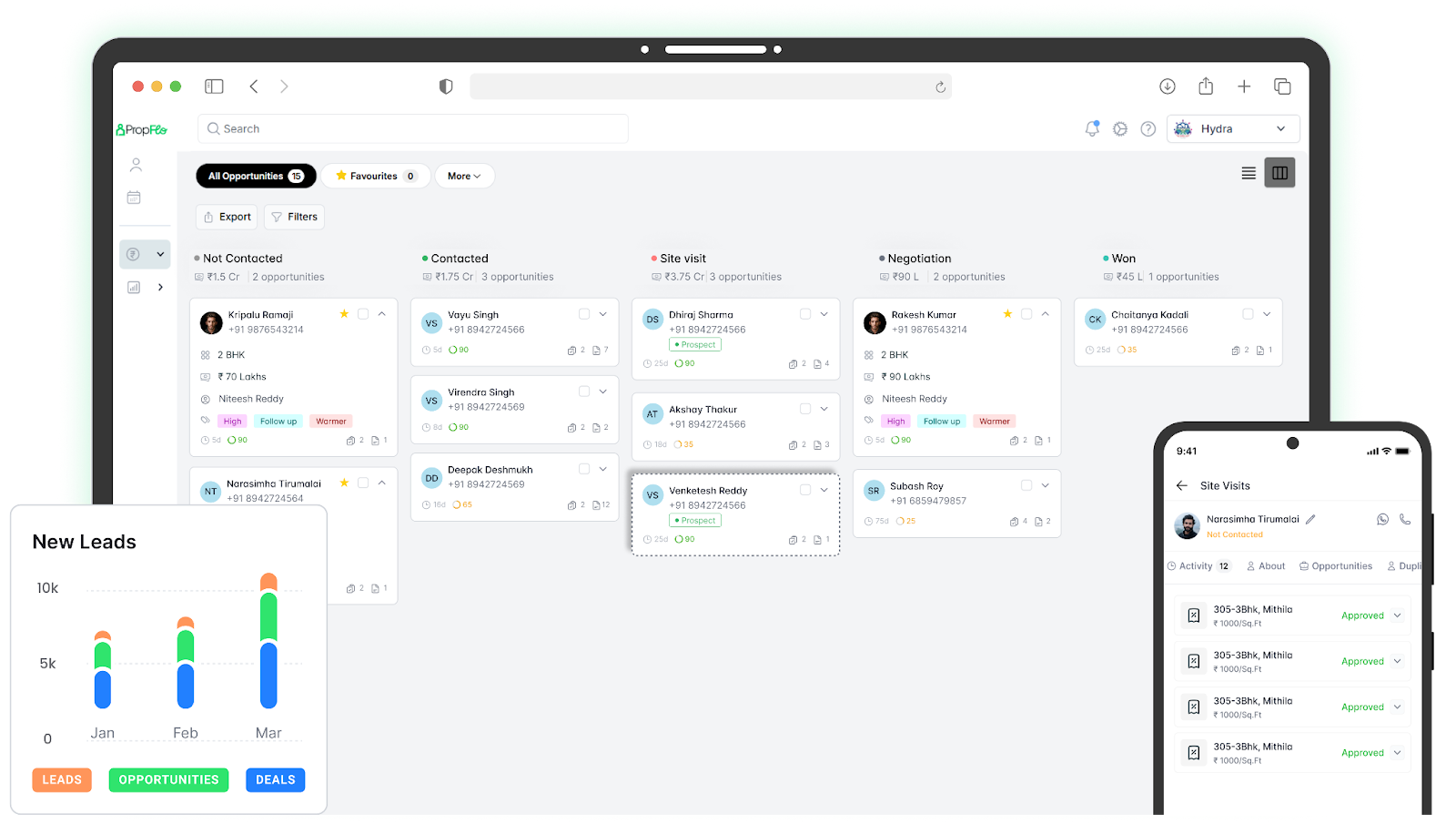
1. Contact & Lead Management: The Core Database
A CRM’s foundation is a centralised database where all customer and lead information is stored, including contact details, company data, previous interactions, and communication history.
Why it matters:
-
No more scattered spreadsheets or sticky notes.
-
Everyone in the team, from sales reps to marketing execs, works off the same “single source of truth.”
-
Enables personalisation in every customer interaction.
Imagine an agent following up with a client. Instead of asking basic questions, the rep can instantly see past conversations, preferred property types, and even objections raised earlier.
Business impact: Better prepared teams, improved conversion rates, and a seamless customer experience. This is one of the most fundamental characteristics of a good CRM.
2. Sales Pipeline & Deal Tracking: Visibility Into Every Stage
A visual pipeline that shows where every deal sits in the sales process (new lead → contacted → demo → proposal → closed).
Why it matters:
-
Gives clarity on the health of your pipeline.
-
Managers can forecast revenue accurately.
-
Helps identify bottlenecks where deals often get stuck.
A startup using CRM notices that 60% of deals stall at the “proposal sent” stage. With this insight, the team refines their proposal templates and follow-up process—leading to higher win rates.
Business impact: Data-driven forecasting, shorter deal cycles, and proactive sales management.
3. Marketing Automation & Campaign Management
Automation of campaigns like email sequences, drip marketing, SMS reminders, or WhatsApp updates, all triggered by customer actions.
Why it matters:
-
Keeps cold leads warm until they’re ready to buy.
-
Reduces manual workload for marketing teams.
-
Ensures consistency in communication.
A customer downloads a whitepaper. The CRM automatically enrols them in a drip campaign, sending them case studies, testimonials, and eventually an invitation for a sales call.
Business impact: Increased engagement, higher lead-to-customer conversion, and better ROI on marketing spend. Truly one of the CRM features that will benefit your business.
4. Task Automation & Reminders: No Lead Left Behind
Automating repetitive tasks such as data entry, call reminders, follow-up emails, or scheduling meetings.
Why it matters:
-
Reduces errors and missed follow-ups.
-
Saves significant time for sales teams.
-
Ensures consistent, professional client engagement.
A CRM automatically reminds a sales representative to follow up with a hot lead who requested a demo three days ago, ensuring no opportunity is overlooked.
Business impact: Higher productivity, improved follow-up discipline, and more closed deals.
5. Advanced Analytics & Reporting: Turning Data Into Insights
CRMs track performance through dashboards and reports that show KPIs across sales, marketing, and service.
Why it matters:
-
Eliminates guesswork—decisions are backed by data.
-
Leaders gain real-time visibility into sales velocity, conversion rates, and ROI.
-
Enables course-correction before problems escalate.
A manager sees that leads from Google Ads convert at 3x the rate of Facebook Ads. With this insight, ad spend is reallocated to maximise ROI.
Business impact: Better decision-making, measurable outcomes, and scalable growth. This represents the characteristics of strong CRM software in action.
6. Collaboration & Team Alignment
CRMs allow multiple team members to share notes, tag colleagues, assign tasks, and collaborate on deals.
Why it matters:
-
Breaks silos between sales, marketing, and customer service.
-
Everyone has full visibility into client interactions.
-
Avoids duplicate calls or conflicting messages to the same customer.
Marketing can tag a sales rep on a high-intent lead who just engaged heavily with a campaign, ensuring faster follow-up.
Business impact: Stronger collaboration, unified messaging, and a smoother customer journey.
7. Mobile & Offline Accessibility
Native mobile apps that allow sales reps to access CRM data on the move—even offline.
Why it matters:
-
Critical for field sales teams or real estate agents.
-
Ensures no downtime in areas with patchy internet.
-
Empowers reps to update notes or book follow-ups instantly.
A rep at a client site can pull up account history, log meeting notes, and schedule the next step before even leaving the meeting.
Business impact: Increased agility, higher responsiveness, and always-updated records.
8. Customer Service & Post-Sales Support
Some CRMs also include ticketing systems, customer support tracking, and automated post-sales communication.
Why it matters:
-
Improves customer satisfaction and retention.
-
Ensures clients feel supported after purchase.
-
Strengthens relationships, driving repeat business and referrals.
A customer raises a query via email. The CRM automatically converts it into a ticket, assigns it to the right agent, and tracks resolution time.
Business impact: Happier customers, stronger loyalty, and increased lifetime value (LTV).
Without CRM vs With CRM
Characteristics of a Strong CRM Software in Action
It’s one thing to list features, but the real value of a CRM is seen when those features are applied in practice. To better understand the characteristics of strong CRM software, let’s explore how different businesses leverage these tools to solve real problems.
1. For Startups and Small Businesses
A growing startup often juggles leads from multiple channels, including social media, referrals, events, and email. Without a CRM, data is scattered, and opportunities are lost.
-
With CRM:
-
All leads flow into a single, unified system.
-
Automated reminders ensure no follow-up is missed.
-
Simple dashboards give the founder real-time visibility into the sales pipeline.
Outcome: The business saves time on admin work and focuses energy on relationship-building. This demonstrates the CRM features that will benefit your business even at an early stage.
2. For Mid-Sized Companies Scaling Operations
As businesses expand, managing multiple sales reps, territories, and marketing campaigns becomes complex. Silos often form between teams, reducing efficiency.
-
With CRM:
-
Deal pipelines are standardised across sales teams.
-
Marketing automation ensures consistent lead nurturing.
-
Managers track performance by region, rep, and campaign in real-time.
Outcome: Teams align better, productivity increases, and leaders get accurate forecasts. This highlights how key features of CRM software enable growth while maintaining control.
3. For Large Enterprises with Complex Structures
Enterprises deal with thousands of leads daily across multiple verticals, geographies, and departments. Without strong CRM capabilities, scaling is chaotic.
-
With CRM:
-
AI-powered lead scoring prioritises high-value prospects.
-
Advanced integrations sync CRM with ERP, customer service, and finance tools.
-
Post-sales workflows track renewals, upsells, and support tickets.
Outcome: The organisation runs on a single source of truth, reducing inefficiencies and increasing customer satisfaction. This is a clear example of CRM features & benefits translating into measurable ROI.
4. The Customer’s Point of View
A good CRM doesn’t just benefit businesses; it enhances the customer experience.
-
Without CRM: Customers face delayed responses, repeated questions, and inconsistent service.
-
With CRM: Customers receive personalised outreach, timely updates, and seamless service across every interaction.
Outcome: Higher customer trust, stronger loyalty, and repeat business are exactly what the characteristics of a good CRM should deliver.
Evaluating CRM Features & Benefits: Your Checklist
With so many CRM options available, it’s easy to get overwhelmed by endless demos and feature lists. The key is to focus on the characteristics of a good CRM that align with your business goals. Below is a structured checklist you can use to evaluate whether a system delivers the CRM features & benefits that truly matter.
1. Ease of Use & Adoption
-
Is the interface intuitive for your team?
-
Does it require extensive training, or can staff adapt quickly?
-
Is there a mobile app for on-the-go usage?
Why it matters: The most advanced CRM is useless if your team won’t use it. High adoption = higher ROI.
2. Customisation & Flexibility
-
Can you customise pipelines, fields, and workflows?
-
Does it adapt to your industry-specific processes?
-
Will it scale as your business grows?
Why it matters: Businesses evolve your CRM should evolve with you. Flexibility is a hallmark of characteristics of strong CRM software.
3. Integration Capabilities
-
Does it integrate with your email, marketing automation, accounting, and customer support systems?
-
Can it sync with telephony, WhatsApp, or other communication tools?
Why it matters: A CRM should be a hub, not a silo. Smooth integration unlocks the key features of CRM software for end-to-end visibility.
4. Analytics & Reporting
-
Are dashboards customizable?
-
Can it track KPIs across sales, marketing, and service?
-
Does it provide real-time insights for forecasting and decision-making?
Why it matters: Without analytics, a CRM is just storage. Reporting is what turns data into strategy.
5. Automation & Efficiency
-
Can it automate repetitive tasks like reminders and follow-ups?
-
Does it support automated marketing campaigns and lead nurturing?
-
Does it reduce manual data entry for your teams?
Why it matters: Automation saves time, reduces errors, and keeps your business running smoothly.
6. Vendor Support & Training
-
Does the provider offer onboarding, documentation, and training?
-
Is customer support responsive and accessible?
-
Are updates and improvements rolled out regularly?
Why it matters: A CRM is not a one-off purchase: it’s a partnership. Strong support ensures long-term success.
Conclusion
The CRM you choose will shape the way your business connects with customers, manages opportunities, and scales for the future. A platform with the right characteristics of a good CRM can be the difference between disorganised data and an actual customer success engine.
By focusing on the characteristics of strong CRM software—ease of use, customisation, automation, integration, and reporting you ensure your teams have the tools they need to sell smarter, market better, and serve customers seamlessly. By prioritising the key features of CRM software, such as lead management, pipeline tracking, automation, and analytics, you unlock the full spectrum of CRM features & benefits that directly impact revenue, efficiency, and customer loyalty.
Looking to transform how your business manages customer relationships?
Explore the CRM features that will benefit your business and see how the right platform can help you streamline sales, personalise marketing, and deliver exceptional customer service.
Contact Propflo today for a personalised demo and discover how the right CRM can power your growth journey.