

In the business environment, especially in real estate, retail and commerce, knowing everything about the consumers is a tool for success because the more familiar you are with your customers' needs, the better you can foretell future behaviors and enhance ways of marketing them. Surveys and focus groups are some means of gathering such data, but unfortunately, they help only to the extent of bringing out limited inferences and so take much more time and energy.
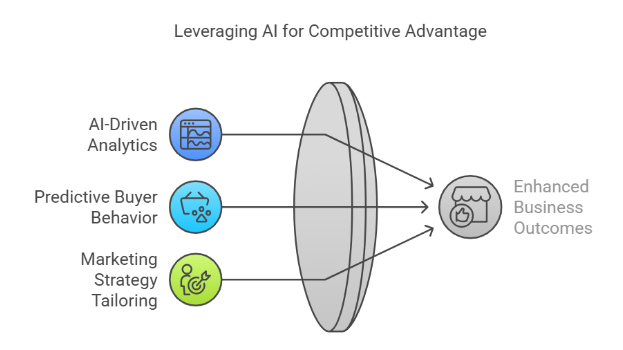
That's where AI analytics come in. Machine learning and data analysis can predict buyer behavior to a certain degree of accuracy for businesses. This blog discusses what AI-powered analytics are, how they help in predicting buyer behavior, and why they're the need of the hour for companies looking to compete with others in the market.
What is AI-Powered Analytics?
This means using artificial intelligence and machine learning algorithms in the analysis of big data and discovering patterns and trends that cannot be discovered using traditional analytics, which involve manual analysis. Traditional data analytics have limited capacity, especially when processing huge amounts of data in real time; hence, they cannot provide the deep insights like AI-powered analytics tools. Such systems "learn" from the data they analyze and become increasingly accurate over time.
AI analytics can trace the kind of buyer behavior in terms of how potential buyers may relate to the product, websites, or advertisements and even predict the forthcoming kind of buying pattern based on past ones. It removes guesswork that forms part of marketing strategies, thus making it easy for businesses to fit their approach into meeting and satisfying customers better.
Why Buyer Behaviour Predictions Are Important
Understanding and predicting buyer behavior is important for businesses in many industries. The more accurately you can forecast what your customers want and need, the better you can adjust your marketing, sales, and customer service strategies. Here are a few reasons why predicting buyer behavior is important:
-
Personalized Marketing: It allows you to formulate and design personalized marketing campaigns that actually speak to customers' needs when you know the things they tend to buy or what product category they are more interested in.
-
Improve the customer experience Improved customer relationship management arises through prediction of buyer behavior: the ability to foresee what customers would like and then to supply it to them at the appropriate time.
-
Optimized inventory management: The idea is that when a business predicts which products have the highest chances of sales, it stocks up accordingly to avoid overstocking or understocking, increasing profitability.
-
Increased Sales Conversion: When marketing efforts are based on predictive data, you’re more likely to target the right audience with the right offers at the right time, resulting in higher sales conversion rates.
-
Competitive Edge: Companies that effectively use AI to predict behavior stay ahead of competitors who are still relying on traditional methods of understanding consumer actions.
How AI Predicts Buyer Behavior
Artificial intelligence-powered tools blend historical data with behavioral data as well as in real time and use that blend to make the prediction about what a buyer will do next. Here is the process involved.
1. Collection of data: The very first step that one takes for prediction of behavior about the buyer would be data collection. This includes web interaction page visits, number of clicks, and time on a page. Former purchases, which history has browsed Interactions on social media: likes, comments, shares. Demographics, such as age and location, etc. Customer feedback-Surveys, ratings, and reviews are more data; the better your predictions probably are.
2. Identify Patterns
Once the data is gathered, algorithms of AI analyze it and find out which patterns exist. For example, it can bring up which behavior mostly goes along with a purchase made. Customers who visit a product page and spend more than five minutes on it are most likely to buy something. This is one pattern that AI will recognize.
3. Segmentation
AI can also be used to categorize customers along common characteristics or behaviors. For example, it may earmark a slice of customers who have repeatedly bought specific commodities or are bound to raise sales following several interactions. This allows for highly targeted approaches toward marketing.
4. Predicting future behavior
The understanding of past behavior by AI helps predict future actions. For example, AI could predict that a customer is most likely to buy a particular product because of the history of browsing that customer has made and similar past actions of other customers. This enables businesses to know what customers want and to show them the appropriate products or promotions at the right time.
5. Continuously learn
This is one of the best features of AI-powered analytics—that it learns continuously. As more data is captured and analyzed, the AI system keeps on growing in its accuracy for making predictions. Therefore, the business will not miss a step as behaviors of buyers shift with these quick adaptations to new trends and their consumer preferences.
Applications of AI in Predicting Buyer Behavior
1. Personalized Recommendations
In the real estate industry, PropFlo’s predictive CRM analytics work on parameters like user engagement, conversion and profile, and based on that information and analysis, it derives lead scoring, which is used to prioritize the leads in the CRM system.
Amazon and Netflix are some of the e-commerce firms that make use of AI for customized recommendations based on previous behavior. In fact, by earlier purchases, browsing patterns, or even by customer profiles showing similarities, AI can suggest to them the products or services they are likely to buy.
2. Dynamic Pricing
AI can predict demand patterns and adjust the prices in real time. For example, if it predicts that some product will increase in demand at a certain time of the season, it automatically adjusts its price to maximize sales.
3. Churn and Retention Forecasting
Artificial intelligence can predict the at-risk customer to leave or to unsubscribe from the service. For instance, business may analyze some behavioral cues (for example, lesser activity and poor reviews), hence taking early preventive measures through offers of discount and personalized support in order to hold such value customers.
4. Targeted Advertising
Predictive analytics can also be used to optimize digital advertising. By understanding which ads resonate with specific customer segments, businesses can allocate their marketing budget more effectively, showing the right ads to the right audience at the right time.
5. Sales Forecasting
AI tools can predict future sales trends based on historical data. This enables businesses to make more informed decisions about inventory management, staffing, and marketing strategies.
Challenges and Ethical Considerations
Even though analytics powered by AI offer significant advantages, they come with significant challenges and ethical issues.
Data Privacy: Collecting and processing customer data can raise privacy issues. Companies must ensure they are compliant with data protection regulations like GDPR and be transparent with customers about how their data is used.
Bias in Data: AI features are only as good as the data they are trained on. If such biases are presented through their data, the predictions may also get skewed. Thus, it is essential for businesses to use diverse and representative datasets.
More, such over-reliance on automated data may be seen as wrong and over-reliant on technology because human judgments are still vital in interpreting results from AI.
Conclusion
AI-powered analytics can transform the way any business predicts buyer behavior. By using machine learning and real-time data analysis, business organizations can assess preferred customer behavior and supply the demanded good/inventory in advance. So, they will be able to increase customer engagement while driving conversions and keeping ahead of the game.
However, with big power comes big responsibility. Businesses have to deal with data ethically, ensure that their AI models are fully trained on diverse data, and be transparent with their customers. If done correctly, AI can open new opportunities for companies and allow them to thrive in the business landscape.