

Customer Relationship Management (CRM) software is an essential business tool in today's day and age, helping companies manage leads, automate workflows, and customer interaction. However, when it comes to real estate, not all CRMs are created equal. Real estate agents tend to use generic CRMs and realize that the software does not offer the exact functionality required for handling property transactions, leads, and industry workflow automation. This blog discusses why a real estate-specific CRM performs better than generic CRMs and how your business can be transformed through it.
What is a Real Estate-Specific CRM?
A real estate CRM is specifically designed to cater to the requirements of the real estate industry only. It has built-in functionalities and many automated procedures, making it easier for a business to operate through all its stages. They provide client relationship functionalities for developers, brokers, and agents. These CRMs are designed with real estate workflow in mind so that they can have a smooth user experience. They do not charge for all the upgrades and customizations. They have an affordable setup cost. And in most CRMs, training is free. Customer support is easier due to the same industry factor. It has an automated marketing system and effective pipeline management for a smooth client experience.
What is a Generic CRM?
A generic CRM is not specifically designed for a particular industry and serves all industries. Generic CRMs such as Salesforce or Zoho offer a flexible solution to companies across the industries. They possess good automation and analytics, but they require major customizations that suit your industry and business. They would require third-party integrations into the system and many more feature requests that a generic CRM lacks. They lack inbuilt features that are industry-specific. These systems need more time to implement and training programs for the team to navigate easily. They charge for updates and integrations despite having a base price.
Limitations of Generic CRMs in Real Estate
Although generic CRMs are strong, they have several limitations when implemented in real estate businesses:
-
Requires Advanced Customization: Generic CRMs take a lot of configuration and added third-party connections to accommodate real estate processes.
-
No Inbuilt Property Management Features: Generic solutions lack inherent direct property listing and management functions as compared to real estate-specific CRMs.
-
No Comprehensive Transaction and Contract Management: Real estate transactions have multiple players, paperwork, and legal regulations that generic CRMs do not natively manage.
-
Poor Lead Nurturing for Real Estate: General CRMs process leads but fail to have industry-tailored automation such as property match notices and follow-up alerts based on customer activity.
-
Climbing the Learning Curve: Most general CRMs contain sophisticated interfaces demanding extensive training, while real estate CRMs cater to professionals with little setup.
Also read article on - AI in Real Estate
Benefits of a Real Estate-Specific CRM
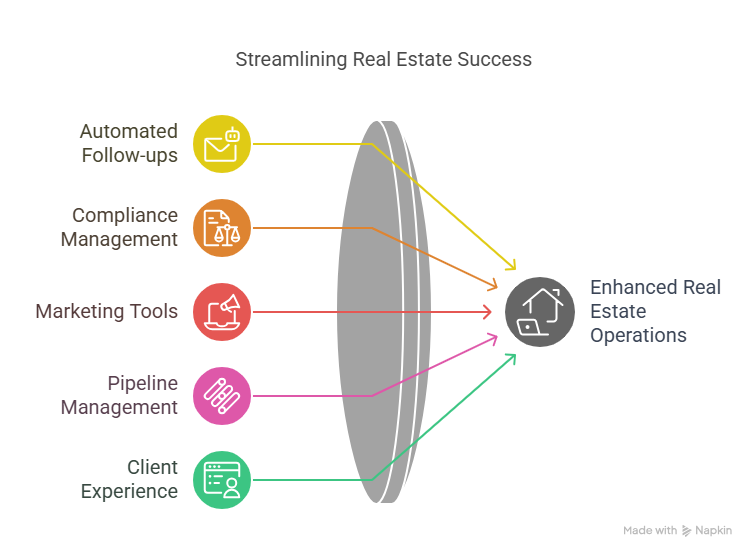
Investing in a CRM with real estate as its primary focus has numerous advantages, wherein in a single unified system you get all the real estate industry features as per the requirements.
-
Automated Follow-ups and Drip Campaigns: Reach clients with tailored communications stemming from their activities.
-
Transaction and Compliance Management: Easily manage legal documents, contracts, and deal tracking.
-
Pre-built Marketing Tools: Create and send marketing campaigns through email, WhatsApp, and social media.
-
Effective Pipeline Management: View deals in multiple stages and fine-tune sales strategy for enhanced conversions.
-
Smooth Client Experience: Provide a customer portal where clients can get real-time updates about their property and construction progress, milestones communication, documentation, and their transactions.
Cost and Efficiency Considerations
Generic CRMs are typically very pricey in terms of licensing fees and charges for customizations, integrations, and training employees. Real estate CRM pricing is affordable because they offer pre-configured, industry-specific tools that minimize the need for costly revisions and comprehensive IT services. In addition, industry-specific CRMs make business processes more efficient, enabling developers, agents and brokers to close transactions quicker with less administrative headache.
Real Estate CRM vs. Generic CRM: A Cost-Benefit Analysis
It’s always essential to check both the initial costs along with long-term benefits while choosing between a real estate-specific CRM and Generic CRM. both types offer a similar range of features, but the difference lies in how they approach the needs of real estate professionals. Here’s a breakdown of the cost and benefit factors involved.
1. Initial Setup Costs
-
Generic CRM: Generic CRMs like salesforce and Zoho provide a base cost but charge extra for setup, customizations, and integrations. This can include hiring consultants, investing in third-party applications, and configuring the system to handle tasks like property management, lead generation, and transaction tracking.
-
Real Estate CRM: A real estate CRM is built keeping in mind the industry and its needs. That means it requires fewer customizations. Real estate CRMs are pre-confirmed to align with real estate workflows so that software is implemented more quickly.
2. Ongoing Maintenance and Upgrades
-
Generic CRM: Maintenance costs keep increasing due to ongoing customizations and third-party integrations that are required. There will be continuous tweaks, and training is required for the team to use the complex features. This can add to the total cost of ownership.
-
Real Estate CRM: A real estate CRM is maintained and updated according to the real estate trends. There is no extra charge for constant fixes, updates and support. As the system is designed to your needs, maintenance is more streamlined and less expensive.
3. Return on Investment (ROI)
-
Generic CRM: Generic CRMs are considered costly due to their built-in features, cost of implementation, and training cost. Also, customization comes at a heavy price in this software.
-
Real Estate CRM: In real estate CRM, the ROI is immediate. The crm softwares designed in such a way that your lead to conversion should be quicker and meet all the requirements of real estate developers abd agents.
4. Training and Support
-
Generic CRM: Generic CRMs require more time in training and are quite expensive. Salesforce, for example, has a steep learning curve and requires training programs for real estate professionals. Support will not be industry-specific, and you will not find an expert to handle your queries on a time-to-time basis.
-
Real Estate CRM: Real estate CRMs require little to no customizations, and support teams know about the challenges faced by real estate businesses, making for faster and more accurate help. Onboarding is quick, reducing the cost and time.
Conclusion
CRM software like Salesforce and Zoho are well-established and capable brands in the CRM industry, but still they do not cover 100% of the ground for any particular industry, and that is why more companies are looking for industry-specific CRM software. A real estate CRM is an end-to-end platform that streamlines property management, maximizes client interactions, and improves the closure of deals. For example, by opting for a niche CRM, real estate companies can realize greater efficiency, improved customer experiences, and higher profit margins with less frustration from unnecessary customization and debilitating learning curves. The right CRM is an investment—not an option—it's a game-changer for the real estate market. You can definitely consider the best CRM option, like PropFlo for the real estate industry, which will help you in streamlining the real estate operations right from lead enquiry to possession