


Imagine you are a developer who completed the construction of a project consisting of 300 Flats. Now the project is ready to market the units.
However, real estate is always unpredictable. During the first quarter, 120 units were sold in just a month. In the next quarter, the demand decreases. Even after many marketing attempts, nearly 170 units were left unsold. And there is no insight into which flats are attracting customers, and your sales team was unable to track the units.
The entire process becomes disorganized; this leads to delays in follow-ups, miscommunication and many opportunities slip away.
This is where inventory management through a CRM comes into the picture. Think about a platform that can manage all the units in one place. CRM systems help you have an overall view in just one dashboard. They manage the entire pipeline and also help track every unit.
What is Inventory?
Inventory refers to the goods or products that a business holds for selling, production or service delivery. It also includes the assets that a company has. It’s important to maintain inventory in an efficient manner to ensure proper productivity.
WHAT IS REAL ESTATE INVENTORY?
Real Estate is always an unpredictable industry. There might be a high demand for houses in the first quarter, and a sudden decline by the next quarter. It is not always easy to survive here. Sometimes the sellers might end up with all units sold in a month to no unit being sold for the entire quarter. For aggregators, inventory might refer to the properties that are to be rented.
Inventory in real estate is a term used to refer to the no. of units unsold either in residential or commercial.
Developing a property is never easy. It is a long and complex process, requiring a detailed plan covering initiation, launch, and completion. A crucial factor that comes into play is demand forecasting. Based on certain factors of demand, the developers come to a count of the number of units for a project.
What are the Key metrics used to measure inventory?
-
Months of Inventory - The estimated time required to sell the available units, excluding upcoming developments.
-
Absorption rate - The speed at which the market is consuming the available inventory.
-
Absolute Inventory count - The total number of unsold units at any given time.
Strategies to manage inventory
Managing inventory and organization might be a tedious process whether you are already a big developer or just starting the real estate business. But with proper knowledge and understanding, you can level up your game.
With certain strategies, you can better manage your real estate inventory and remain ahead of the competition.
-
Just-in-Time (JIT) Inventory: This strategy reduces excess inventory by holding/ordering inventory only when it's needed. This also minimizes storage costs.
-
ABC Analysis: Categorizes inventory into three groups - A (high-value, low-quantity), B (moderate-value, moderate-quantity), and C (low-value, high-quantity)—helping businesses prioritize Inventory management.
-
First-In, First-Out (FIFO): This method ensures older inventory is sold first, reducing the risk of obsolescence.
-
Economic Order Quantity (EOQ): This determines the optimal order quantity to minimize the inventory costs.
-
Demand Forecasting: Uses data analytics to predict future inventory needs and prevent shortages or overInventorying.
How CRM helps in managing Inventory
Customer Relationship Management (CRM) systems are not just for managing customer interactions; they also play a significant role in inventory management.
-
Real-Time Inventory Tracking: CRM integrates with inventory management systems to provide real-time unit updates.
-
Demand Analysis: CRM predicts future inventory requirements based on customer purchase history.
-
Automated Order Processing: Eliminates manual errors and facilitates simple order fulfillment.
-
Supplier Relationship Management: Facilitates businesses in monitoring supplier performance for timely re-inventorying.
-
Multi-Channel Inventory Management: CRM allows businesses to monitor inventory through multiple sales channels using a single platform.

How to calculate inventory real estate?
The Real Estate Inventory is calculated by involving the total expenses of both owning and managing the property before it is sold or rented. In real estate, the cost includes many factors. You can calculate inventory costs considering the below components:
Key Components of Real Estate Inventory Costs
-
Acquisition Costs:
-
Purchase Price: The initial tentative cost while buying the property.
-
Closing Costs: Closing costs are the fees that are related to purchasing a property like insurance, attorney fees and other similar expenses.
-
Real Estate Agent Fees: These are the commissions paid to agents who are involved.
-
Carrying Costs (Holding Costs):
-
Property Taxes: the ongoing taxes that are to be paid to the government for holding a property.
-
Insurance: Costs for insuring the property, including liability and hazard insurance.
-
Maintenance & Repairs: Routine maintenance or necessary repairs to keep the property in good condition while it is being held.
-
Utilities: If the property is being held for a longer period, utilities such as electricity, water, and gas can add to the cost.
-
Financing Costs: Interest on any loans or mortgages taken to purchase or finance the property.
-
HOA Fees: If the property is in a community with a Homeowners Association, regular fees may be charged.
-
Development Costs (if applicable):
-
Renovation and Construction Costs: Costs of improving or developing the property before resale or rent, including labor and materials.
-
Permitting & Fees: Costs for obtaining permits and approvals for any construction or renovation work.
-
Selling Costs (if applicable):
-
Real Estate Agent Commission: Typically 5-6% of the sale price, paid when the property is sold.
-
Marketing Expenses: Costs associated with advertising and marketing the property for sale or lease.
List of Top 5 Inventory Management Software
A number of software tools facilitate businesses in tracking and managing inventory.
Some popular inventory management software are:
PropFlo:
PropFlo is an AI-powered CRM for real estate developers providing inventory management crm with automated tracking of sales and customer engagement. PropFlo has served as the best choice for various companies to operate their inventory. PropFlo provides real-time alerts about available units, price modifications, and inquiries from customers, allowing property managers to monitor and control real estate inventory effectively.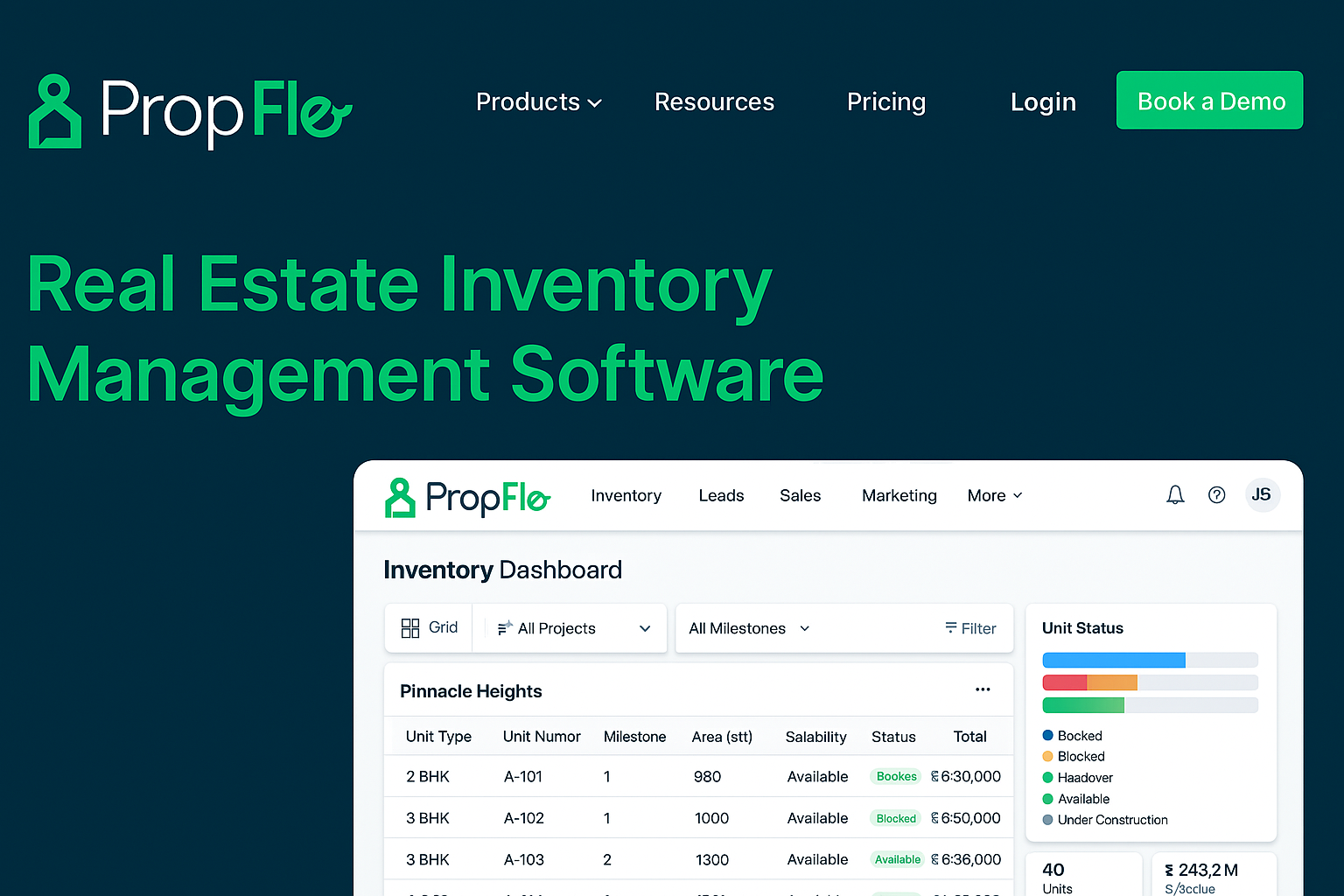
Key Features:
-
Inventory Management - Monitor live inventory and statuses through live inventory creation and updates tools with grid and list view, milestone creation, bulk import inventory, interactive dashboards, custom parking allocation rules, and handover checklists.
-
Marketing Automation - Automate mundane marketing activities such as lead follow-ups and campaign management. They include automated lead capture and nurturing, communication automation, whatsapp marketing, bulk messaging and marketing workflow automation.
-
Sales Management - Manage leads with a view to monitoring customer interactions to generate profitable sales outcomes. Functionality provided by PropFlo includes task automation, follow-up automation, pipeline customization, site visit management, cost accounting, inventory booking and mobile access.
-
Reports & Dashboards - Receive necessary data and intelligence in minimal time with interactive dashboards and reports, with real-time monitoring and decision-making.
-
Third-party Integrations - Add capability with simple third-party integrations from other social media platforms, such as Facebook and Google lead gen ads, web forms, Whatsapp, email, and many more.
-
Omni-Channel Communication - Stream all the customer interactions on all the channels with ease, allowing communication through email, Whatsapp and even a customer portal.
-
AI Features - Utilize AI for smart automation and data-based insights, i.e., an AI sales assistant for 24x7 website engagement with call scheduling or site visit capability, an AI content writer, predictive analytics and lead scoring.
-
Post-Sales Management - Automate post-sale customer satisfaction and loyalty from sale closure automation through to payment tracking, milestone management, document management, and automatic notification of customer requests.
Zoho:

Zoho is an automated, cloud-based platform with order management, inventory tracking, and multi-channel selling. Zoho Inventory integrates easily with online stores like Shopify, eBay, and Amazon and allows companies to monitor sales and inventory from a single system.
Key Features:
-
Sales Management - Zoho CRM provides a solid sales pipeline management system, which helps companies track deals, assign tasks, and collaborate between teams. It enables salespeople to rank leads, track progress, and close deals effectively with AI-infused insights and automation.
-
Omnichannel Communication - Connect with customers on different channels - email, phone, live chat, and social media - within the Zoho CRM. All from a single integrated interface for efficient communication and customer interaction with consistent and trackable follow-ups.
-
AI-Powered Insights (Zia AI)—Zia, Zoho CRM's AI assistant, aids businesses in fact-based business decisions with predictive analysis, forecasting, and insightful suggestions. Zia not only suggests contact timing for leads but also identifies differences in sales patterns to optimize team productivity.
NetSuite ERP:

It is a full-fledged warehouse and inventory management solution for large businesses. NetSuite ERP offers extensive analytics, automated demand forecasting, and supply chain optimization to enhance operational efficiency.
Key Features:
-
Financial Management - NetSuite ERP encompasses all-around financial management capabilities, such as real-time accounting, revenue recognition, and tax compliance. It assists businesses in automating finance processes, guaranteeing accurate reporting and regulatory compliance.
-
Inventory and Supply Chain Management - NetSuite offers real-time insights on inventory levels, demand planning, and order fulfillment. Companies can automate Inventory levels, minimize carrying costs, and simplify supply chain operations to drive efficiency.
-
CRM and Sales Automation - The platform merges CRM with ERP functionality, enabling businesses to take charge of customer relations, streamline the sales function, and track interactions. The merged approach raises customer interaction and drives sales momentum.
Odoo Inventory:

Free inventory management software that tracks inventory in real-time. Odoo allows businesses to automate Inventory, manage multiple warehouses and connect with other business processes such as sales and accounting.
Key Features:
-
Smart Double-Entry Inventory System - Odoo Inventory's two-way Inventory management avoids Inventory input, output, or conversion errors. It tracks every Inventory movement from procurement to delivery level and offers real and accurate inventory visibility.
-
Barcode Scanning & Automation - It comes with barcode scanning capabilities for streamlined management of inventory, order handling, and warehouse management. This eliminates human mistakes, accelerates Inventory tracking, and maximizes operating efficiency.
-
Multi-Warehouse Management - Odoo enables multiple warehouses and locations to be easily managed. Transferring Inventory, tracking shipping, and storing space can be optimized by the users, ensuring greater supply chain efficiency.
Ordoro inventory:

Suitable for small and medium-sized enterprises, it offers inventory control and analytics. It allows companies to synchronize their inventory in various channels, optimize purchase orders, and monitor the performance of suppliers.
Key Features:
-
Multi-Channel Inventory Synchronization - Ordoro is meant to sync inventory with multiple selling channels such as Shopify, Amazon, and eBay and provides instant updates of inventories across channels. This eliminates the variation of Inventory and the problems of overselling.
-
Automated Order Fulfillment & Shipping Management - The solution enhances processing of orders through automated shipping jobs, offers of discounted rates by shipping companies, and provides labeling. It lowers business costs on processing orders faster.
-
Advanced Reporting & Demand Forecasting - Ordoro offers detailed analytics and forecasted data to allow companies to make inventory decisions with data. It helps in tracking Inventory levels, identifying trends, and optimizing purchasing strategies.
Apart From Real Estate which Industries require Inventory?
Inventory management is critical in various industries, including:
Retail: Maintains inventory levels in sync with customer needs and sales patterns. Retailers depend on inventory management to maintain shelves full of the correct products without overInventorying or inventorying out.
Manufacturing: Manage raw materials, work-in-progress, and finished goods to optimize production cycles. Manufacturers need to have accurate inventory control to offer smooth production processes and minimize waste.
E-commerce: Track inventory across many sales channels and fulfillment warehouses to provide timely order fulfillment. Online retailers use inventory tracking to prevent Inventoryouts and handle large order volumes.
Healthcare: Regulates medicines, drugs, and equipment to ensure against shortages and ensure patient safety. Clinics and hospitals must have strict control over inventory to comply with the law and ensure critical medical equipment is available when needed.
Automotive: Controls spare part inventory and ensures efficient supply chain operation for car assembly and repair. Repair facilities and dealerships need precise tracking to have critical parts on hand.
Food and Beverage: Tracks perishable Inventory, avoids spoilage, and maximizes Inventory replenishment based on changing demand. Restaurants, grocery stores, and food distributors depend on inventory control to maintain food safety and minimize waste.
Real Estate and Construction: Tracks Sells and manages unsold apartments and flats and manages building materials, appliances, and fixtures to prevent project delays with supplies. Developers and contractors keep inventory on hand in order to keep projects on schedule and budget.
Which Software is Recommended for Inventory Management?
Successful inventory management is key to business success, allowing for ideal Inventory levels, cost savings, and enhanced customer satisfaction. Through the use of key inventory metrics, embracing strategic management techniques, using CRM technology, and incorporating sophisticated inventory management software, companies can streamline their operations and increase profitability. As industries become increasingly dynamic, embracing cutting-edge inventory management solution will continue to be pivotal to remaining competitive and addressing market needs. Investing in the appropriate technology and best practices will not just make things more efficient but also contribute to long-term business expansion. PropFlo Real Estate CRM is highly recommended crm software that plays a very crucial role in managing the real-time inventory and equips you with the best technology and customer support, where you can focus more on closing the deals.