


Overview of 2024
In 2024, India's real estate market showed robust performance, driven by several key factors:
-
Residential Real Estate: The residential sector continued to thrive, particularly in the affordable and mid-range housing segments, bolstered by government schemes like Pradhan Mantri Awas Yojana (PMAY). The shift towards suburban and semi-urban areas was evident, as increasing urbanization and migration pushed demand in tier 2 and tier 3 cities. Demand for luxury and ultra luxury homes among wealthy Indians went up and this was primarily on account of few launches in the luxury housing segment and the fear of missing out on the most desirable properties in town. There is less supply chasing high demand for luxury properties, especially in markets such as Mumbai, Gurgaon and Delhi.
-
Commercial Real Estate: The office space market experienced steady growth, despite the ongoing hybrid work trend, with demand largely coming from the IT and tech sectors, along with multinational corporations. There was also a rising interest in co-working spaces, driven by startups and flexible work environments.
-
Industrial and Warehouse Real Estate: Industrial real estate showed great traction. As e-commerce became more prominent, and the whole supply chain ecosystem began to evolve, there was a lot of demand for warehouse and logistics-related facilities.
-
Retail Sector: In 2024, the retail sector saw a modest recovery. High-street retail and organized retail formats, like malls, became more popular, particularly in urban areas, as people returned to shopping in physical stores. The convenience of online shopping, however, continued to challenge traditional brick-and-mortar retail, pushing businesses to adapt. Many retailers started focusing on creating more immersive and unique in-store experiences to draw customers in, balancing both the digital and physical shopping worlds.
Overall, 2024 was a year of stabilization and recovery for the real estate market, especially as it bounced back from the pandemic's disruptions. Developers were focused on completing projects on time and improving transparency, which was largely driven by reforms like RERA (Real Estate Regulatory Authority). These efforts were aimed at building trust with consumers and ensuring better accountability in the sector.
India's Real Estate Market in 2025:
The growth pace in the Indian real estate market will become faster, accelerating into 2025. Here's an elaborative analysis of the size, growth trends, and forecast of its future development: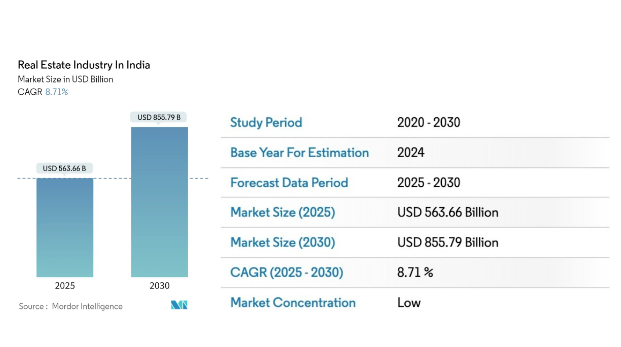
1. Market Size in 2025
The Indian real estate market is likely to be around $400-450 billion by 2025, significantly higher than in 2024. Residential and commercial segments are expected to grow steadily, with the pace continuing in affordable housing and industrial real estate segments.
2. Growth Rate and Projections for 2025
Urbanization, government incentives, a rise in incomes, and growth in foreign investments are the aspects that expect 8-10% of the compound annual growth rate between 2023 and 2025 for Indian real estate.
The residential real estate sector is likely to continue its growth at 7-8% per annum mainly driven by demand for affordable housing in smaller cities.
Commercial real estate is expected to grow at 10-12 percent, stimulated by the growth in the economy and mainly the office space demand, mainly for grade A buildings as well as flexible office spaces.
Industrial real estate, especially warehousing, is likely to grow between 12-14% with the growth of e-commerce and the logistics boom.
3. Key Trends in 2025
a. Increased Urbanization - In 2025, 40% of India's population will be in urban environments. This trend is said to continue to place an ever-growing demand on the availability of residential, commercial, and mixed-use developments.
b. Affordable Housing Trend - Even schemes such as PMAY launched by Governments will fuel up the demand in affordable housing. Developers will see a constant window of developing affordable projects in suburbs to meet a demand that can only go about increasing.
c. Digitalization and PropTech - The integration of PropTech will continue to define the real estate market, bringing property transactions more efficiently and transparently through AI, blockchain, and digital platforms, making the industry rely on this technology.
d. Smart Cities - The government's Smart Cities Mission will boost huge investments in infrastructure, sustainable housing, transportation, and commercial hubs, thereby opening new opportunities for real estate development.
e. Co-living and Co-working Spaces - The co-living and co-working space will be in high demand as more people are moving to cities for work. This will especially be popular among young professionals and startups.
4. Market Share in 2025 by Segment
Residing Real Estate: Expected to have a 60-65% share of the entire real estate market, where the affordable housing sector will remain at the helm.
Commercial real estate would likely constitute around 20-25%, majorly due to office space, especially in tech and IT segments, and the co-working segment.
Industrial Realty: Industrial and warehousing properties will be at 10-12% in the market and the logistic development along with the supply chain continue to be increasing.
Retail Real Estate: Retail space will account for around 8-10%, especially in high-demand urban locations.
5. Investment Trends and Foreign Direct Investment (FDI)
By 2025, FDI is expected to continue growing in India's real estate sector, mainly in commercial and industrial property. Investment will increase due to the continued government reform policy, such as RERA and the introduction of GST, that will make India a more accessible destination for foreign capital.
6. Challenges in 2025
-
Regulatory Compliance: This area has made a lot of progress in terms of regulation, though issues such as delayed approvals and regulations may still act as obstacles to developers. This may result in increased raw material costs, such as steel and cement, that could have an impact on profit margins as well as the project timeline.
-
Debt and Liquidity: Some real estate developers are still struggling with the issues of high debt levels, which may hinder their ability to finance large-scale projects.
Conclusion:
India's real estate market continues to grow throughout 2025, driven by positive economic fundamentals, urbanization, and moving toward more sustainable and digitalized real estate products. The main player will continue to be the residential sector, although commercial, industrial, and retail property will also drive strong performance; these will grow because of shifts in work behaviors, technological development, and improvement in infrastructure. Strong fundamentals in the market, coupled with reforms initiated by the government, make 2025 a promising year for real estate developers, investors, and professionals across India. For real estate developers and channel partners, staying ahead of industry trends and utilization of technology effectively are essential for success. PropFlo CRM system simplifies this process by offering cutting-edge AI technology, marketing automation, and built-in tools designed for ease of use, efficiency, and affordability.