

With real estate CRM, developers and agents can start managing leads and aligning with a pipeline, and also being able to produce an output is never a cakewalk. Have you ever wondered about having a tool that processes and automates all your tasks in one place? By using these CRM tools, you can manage every stage in your business. CRM systems are such tools that are designed specifically to help in all stages of your business growth. Using the right crm for real estate professionals is the key to success. There are two types of CRMs: general CRM & industry-specific CRM.
General CRMs - These are the CRMs that are catered across all industries and not specified only for one industry. They have very common features that can be helpful in all domains.
Industry-Specific CRM - These CRM systems are specifically designed according to the terms and requirements of a particular industry in mind.
Understand the Importance of Real Estate CRM.
A real estate CRM is software that assists developers and agents in real estate to handle leads, automate follow-ups, monitor customer interactions, and organize their sales pipeline — all within one platform. Unlike generic CRMs, real estate CRMs are designed specifically for property workflows: handling listings, tracking site visits, updating inquiry statuses, and following up on interest levels.
They're not merely lead databases - they keep you ahead of your deals, communicate more effectively, and close faster. You can qualify leads as opportunities
Why Choosing the Right CRM Matters
Your CRM isn’t just normal software — it becomes the backbone of your entire sales process.
- The right CRM software helps teams to respond faster and more consistently.
- Reduces manual tasks like logging calls and updating spreadsheets
- Brings transparency into which leads are hot, cold, or ignored
- Improves collaboration between sales, marketing, and admin staff
- Offers data that helps you double down on what’s actually working
Investing in the wrong CRM, however, can lead to confusion, low adoption by your team, and missed business opportunities.
Key Factors to Consider When Choosing a Real Estate CRM
1. Ease of Use
The best CRM is the one your team will actually use. The interface should be clean, intuitive, and mobile-accessible. If agents can’t figure it out quickly, they’ll go back to their notepads or WhatsApp.
2. Customization Options
Every real estate business has a unique sales process. Look for CRMs that let you customize deal stages, lead types, property categories, and workflows — not force you into a rigid system.
3. Lead Management & Segmentation
Your CRM should allow tagging, filtering, and grouping leads — by interest, source (like 99acres, referrals, walk-ins), or timeline. This helps agents prioritize who to call first and follow up with precision.
4. Automation Capabilities
Automated follow-up reminders, birthday greetings, WhatsApp campaigns, or drip email sequences can save hours of manual effort while keeping your brand top-of-mind.
5. Tool Integrations
Does it integrate with the tools you already use — like your website, dialer, WhatsApp Business API, or marketing software? Seamless syncing avoids data silos and repetitive work.
6. Analytics and Reporting
Insights are important. Look for CRMs that show key metrics: how many leads were contacted, which sources perform best, which agents are converting, and where delays happen.
7. Onboarding & Support
Even the best CRM is useless if your team can’t implement it. Choose vendors who offer onboarding help, training, and responsive customer support — especially in local Indian time zones.
8. Scalability & Pricing
Start with a plan that fits your current size — but make sure it’s easy to scale as you grow. Some CRMs offer per-user pricing; others charge based on features or contact volume.
Questions to Ask Before You Choose CRM
Here’s a quick checklist to review before committing:
1) Will my team actually use this tool day-to-day?
Sometimes there is a confusion between needing something and actually requiring it. Do not get fascinated by listening to all the features they provide. Think about if your team actually needs it and if they will be using it on a daily basis.
2) Can I map my existing process into this CRM without much friction?
Migrating from one system to another has never been easy. The solution you choose must be in a way that your entire business workflow should not stop while migrating. There should be a smooth and hassle-free process of adapting to a new system.
3) Does it support the integrations and channels I already use (email, WhatsApp, dialers)?
Many CRMs offer many integrations that are built-in. But check with the integrations that support your business and will help in the process. Check whether the CRM systems are integrating them for better productivity.
4) Is support available via phone or chat during business hours?
For any business, support plays a vital role. Especially when your business is relying on a CRM to manage, the support should be available whenever your team has queries.
5) Is the data stored securely, and is it easy to export if I switch later?
Data security is another important thing to consider while adapting to a CRM. you have to consider the cases wherein you switch to different platforms; will the data transportation be easy or not? And the data that you provided the system is secure or not.
6) Will they have Mobile access?
Having CRM is not a simple process. But imagine having it on a mobile where you can access it from anywhere.
7) Can they generate all the reports within the system?
Many CRMs provide all the features. But consider the CRMs that have report generation within the system so that your team doesn’t have to bother with the documents.
Common Mistakes to Avoid
-
Choosing a CRM based only on cost - Many people, due to budget issues, choose systems that are of low cost. But a good CRM having all the features and automating systems will never come at a low cost. Consider spending some amount on the CRM systems because they can almost do the work in minutes that a team does in 2 days.
-
Going for complex tools that the team can’t adopt - CRMs are not complex but require a little expertise. People with some technical knowledge and industrial knowledge can handle them. So choose the systems that can be convenient for your team members.
-
Picking general CRMs that don’t support property-specific workflows - many people see the brand and choose the CRM. but it is important to check whether they cater to all your requirements in your industry or not.
-
Ignoring long-term support, training, and flexibility - Adapting to a CRM is a never-ending process. So be prepared to always have doubts and queries all the time. So it is best to consider a platform that provides proper support and training.
-
Not checking if you’re locked into annual contracts without a trial—also, do not conclude by selecting one CRM system and fixing to it. Always have a backup and explore as many as you can before choosing. Check the plans properly if you are considering a contract of 6 months or annual contracts ahead of selecting.
Meet India’s #1 Real Estate CRM with Built in AI and WhatsApp For Developers and Channel Partners
1. PropFlo CRM
PropFlo is a top-rated, all-in-one real estate crm that is designed specifically for real estate professionals. Which covers all the aspects of real estate management and provides a better crm alternative to developers and agents with new tech and AI-powered features with exceptional customer support where many enterprise-grade companies lack it.
Once the deal is won, all the post sales activities can be managed directly from PropFlo CRM. making it truly unique software unlike other systems. connecting all company stakeholders, such as finance and CRM teams, to all necessary teams ensures smooth billing, payment collection, handover management and exceptional customer experience.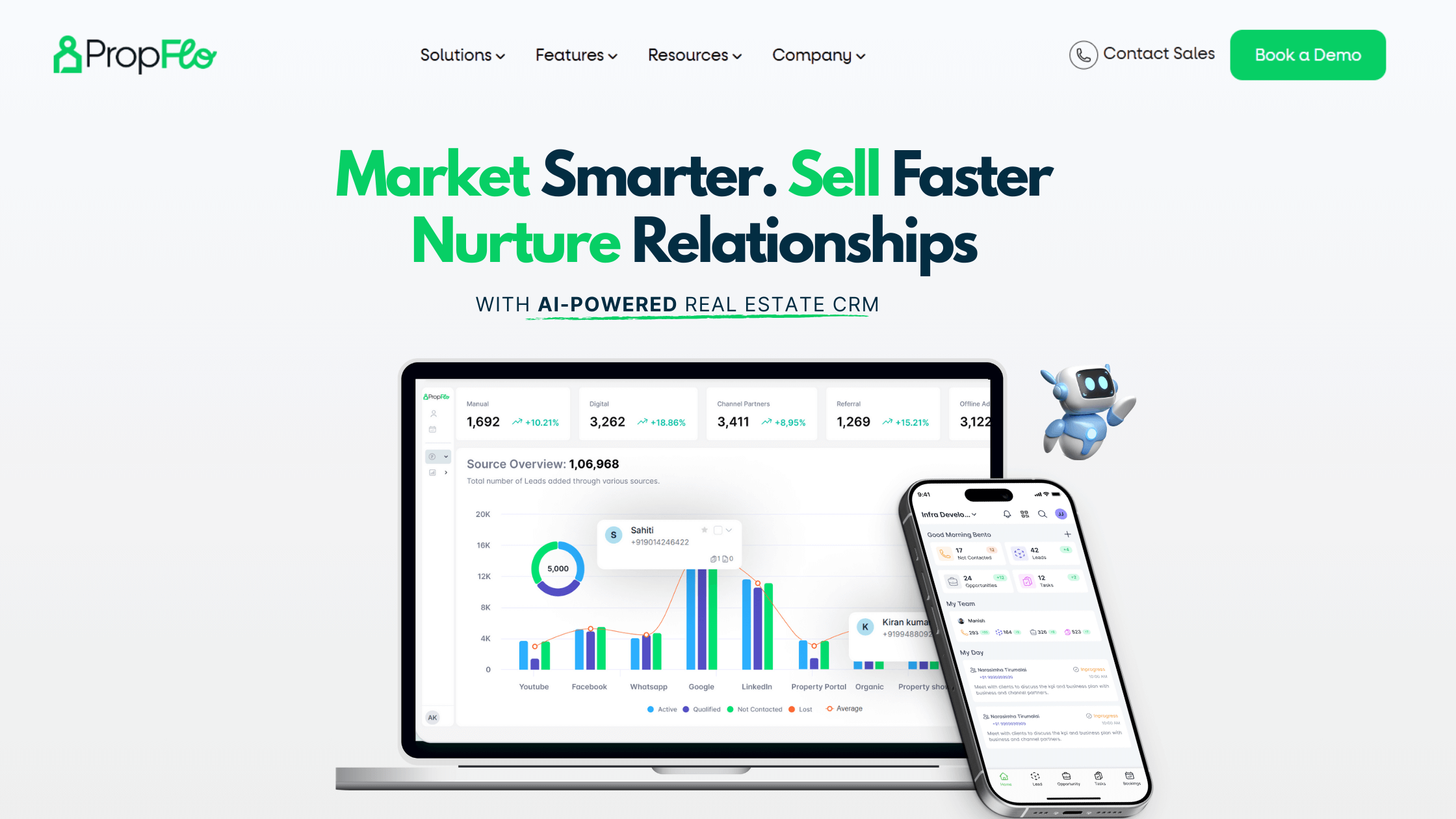
Features:
- Lead Management: Propflo manages every lead after capturing it from different platforms.
- Property Management: Properties are handled, monitors the units and manages all the queries in one platform itself.
- WhatsApp and Telephony Integration: PropFlo has built-in Whatsapp Automation and Mcube Telephony Integration for instant communication with your customers.
- Customizable Reports: Design in-depth reports to track performance and predict sales trends.
- AI-Powered Lead Scoring: PropFlo leverages AI to score the leads on certain parameters and also offers an AI sales assistant to assist salespeople in closing deals faster.
- Mobile App: PropFlo provides a mobile app to make accessibility easy. Salespeople can operate from anywhere just through their phone and do the regular work from the field easily.
- Marketing Automation: Sending automated follow-ups, personalized messages and mails within the system. Also provides inbuilt whatsapp to make the communication easier.
Why PropFlo is a better choice than General CRM for real estate professionals
PropFlo real estate software is specially designed for only one industry, i.e., real estate. PropFlo CRM offers great features along with user-friendly and the best customer support, which many businesses are lagging in in 2025. PropFlo knows exactly what real estate professionals need and provides the solution from the lead inquiry to possession, in which most of the things are automated with AI-powered features, all within PropFlo CRM.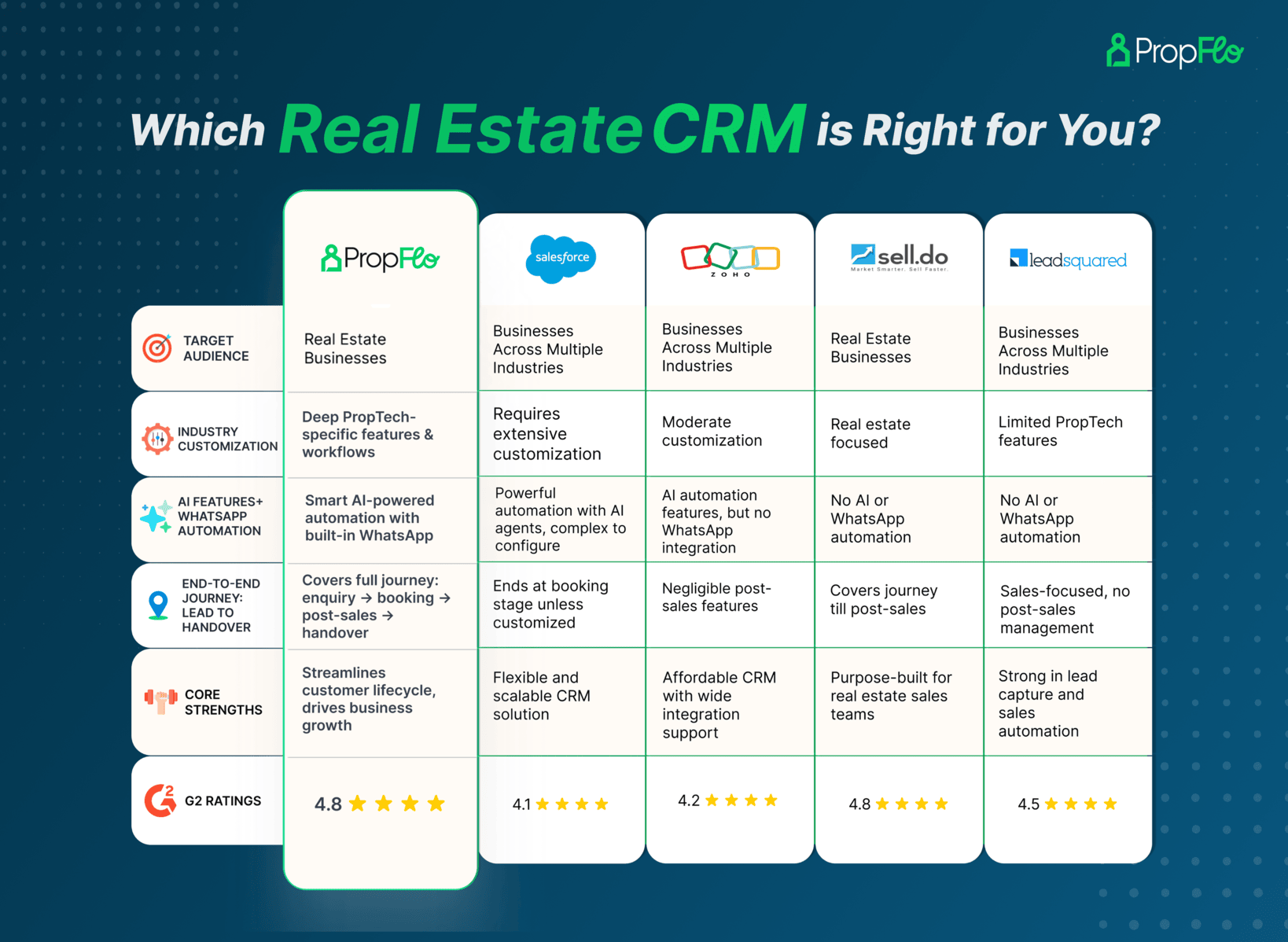
Making an informed decision.
A Sales CRM won’t magically fix your sales problems, but the right one can make your sales team faster, more efficient, and better at converting leads into clients. Don’t just go with the trendiest or cheapest CRM. Instead, test a few, involve your team, and look for a system that supports your actual day-to-day flow.